
What is post-tensioning? A design engineer's guide
Post-tensioning explained from the design side: what the tendons do, how a PT slab is designed and approved in the UAE and GCC, and what has to be right before and after stressing.
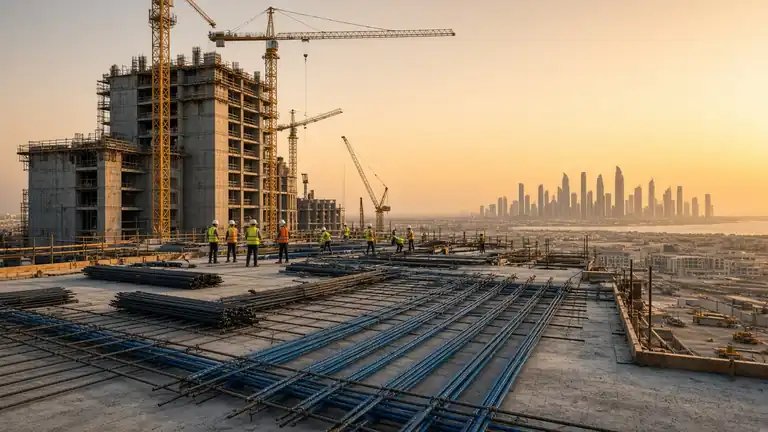
Post-tensioning in one paragraph
Post-tensioning (PT) is a way of prestressing concrete after it has been cast. High-strength steel strands run through the slab or beam inside a sheath or duct, following a curved profile. Once the concrete is strong enough, each strand is pulled with a hydraulic jack and locked off at an anchorage. The locked-in force squeezes the concrete and, because the tendon is draped, pushes upwards where gravity pushes down. The result is a floor that carries the same load with less depth, less reinforcement and far less cracking than ordinary reinforced concrete.
Why the tendon profile matters more than the force
A straight tendon only compresses the concrete. A draped tendon, low at midspan and high over the supports, also creates an upward "balancing" load along the span. Designers usually choose the prestress so that this balanced load offsets a set share of the permanent load, often most of the self-weight. The rest is carried by the concrete and conventional reinforcement. Getting the profile, the drape and the inflection points right is the core of PT design; a strong tendon in the wrong place does little.
- Precompression (force divided by area) controls cracking and keeps the slab in a low-stress state at service.
- Load balancing from the drape controls deflection, which is often what governs thin UAE flat slabs.
- Ultimate strength comes from the tendons plus bonded reinforcement, checked to ACI 318 and the local code.
Bonded and unbonded systems
In the Gulf, most typical floors use unbonded monostrand: a greased strand in a plastic sheath, light and quick to lay. Bonded systems put several strands in a metal or plastic duct that is grouted after stressing; they suit transfer slabs and beams, heavy loads and structures where a cut tendon must not lose force along its whole length. The choice changes the design checks, the anchorage details and what can be cored later. We compare them in detail in bonded vs unbonded post-tensioning.
Post-tensioning vs pre-tensioning
Pre-tensioning stresses the strands before the concrete is cast, normally in a precast factory (hollow-core planks, bridge girders). Post-tensioning stresses them after casting, on site, so it works for cast-in-place slabs of any shape. That flexibility is why PT dominates flat-slab residential towers, car park podiums and transfer floors across the UAE and Saudi Arabia.
How a PT slab is designed
The design decides almost everything the site team later builds. Our typical sequence, using RAM Concept for analysis:
- Scheme: column grid, slab thickness, banded or distributed tendons, pour strips. See preliminary PT design support and flat slab vs banded beam.
- Analysis: load balancing, service stresses at transfer and in service, long-term deflection with creep and shrinkage, and restraint from cores and walls.
- Strength: flexure, one-way and punching shear, and secondary (hyperstatic) effects. Our ACI 318 / PTI checklist lists every check.
- Losses and elongations: friction, wobble, seating and long-term losses, and the calculated elongation for each tendon. See PT losses and elongation calculation.
- Detailing: tendon layout and profiles, anchorage zones and bursting steel (anchorage zone guide), openings and PT shop drawings.
Approval in the UAE and GCC
PT design is submitted through the consultant of record to the local authority. Dubai Municipality, Abu Dhabi, Sharjah and Ajman each have their own PT design and submission criteria, covering items such as the calculation report, tendon layouts, stressing sequence and the qualifications of the designer. In Saudi Arabia the design follows SBC 304 and is stamped by a locally registered office. Our full PT design package is prepared for that route, and the regional pages cover Abu Dhabi, Sharjah and the Northern Emirates and Saudi Arabia.
On site: inspection, stressing and records
Before the pour, the tendon profiles, anchorages and clashes with MEP sleeves are inspected against the shop drawings. Stressing starts only when the concrete reaches the transfer strength set by the designer. Each tendon's measured elongation is then compared with the calculated value; differences beyond tolerance are investigated, not filed. The PT specialist contractor supplies, installs and stresses the tendons; as design engineers we inspect, witness and review. See PT site supervision and stressing and elongation records.
Where PT pays back, and where it does not
PT is usually worth it on spans above roughly 7–8 m, on towers where a thinner slab saves height or adds floors, and on podiums where fewer columns help parking. It is harder to justify on short spans, on small projects, or where many late openings are expected. Our PT vs RC guide for the UAE sets out the trade-offs, and the PT slab thickness estimator gives a first number for your grid.
Quick answers
What is a post-tensioned slab?
A cast-in-place concrete slab containing steel tendons that are stressed after the concrete hardens, so the slab is pre-compressed and partly self-supporting against its own weight.
When are PT tendons stressed?
When cube or cylinder results show the transfer strength specified in the design, commonly a few days after the pour. Some projects stress part of the force early and the rest later.
Can you drill into a post-tensioned slab?
Only after scanning to locate tendons and with engineering approval. See PT slab openings and coring.
Who designs a PT slab?
A structural engineer experienced in PT, either the consultant of record or a specialist PT designer working for them or the PT contractor. A second check through a PT design review is common on larger projects.
For deeper technical notes, see our PT technical series: RAM Concept tips, floor vibration, long-term deflection, shrinkage and creep, friction and wobble losses and tendon elongation calculation.
Talk to us about your PT design. Our team provides preliminary PT design support, full post-tension design packages and site and stressing support across the UAE and GCC. Find out more about our post-tension design in the UAE or contact our engineers.
Questions we are asked about this.
What is a post-tensioned slab?
A cast-in-place concrete slab with steel tendons stressed after the concrete hardens, so it is pre-compressed and partly balances its own weight.
When are PT tendons stressed?
When test results show the transfer strength specified in the design, commonly a few days after the pour.
Can you drill into a post-tensioned slab?
Only after scanning to locate the tendons and with engineering approval.
What is the difference between post-tensioning and pre-tensioning?
Pre-tensioning stresses strands before casting, usually in a precast plant; post-tensioning stresses them on site after the concrete has hardened.
Related services and guides.
Most projects touch more than one of these. The Iron Axis home page has the full overview.
RC vs PT slab comparison calculator
Compare thickness, concrete, rebar, strand, cost per m², weight and height for your grid and rates.
Open the calculator →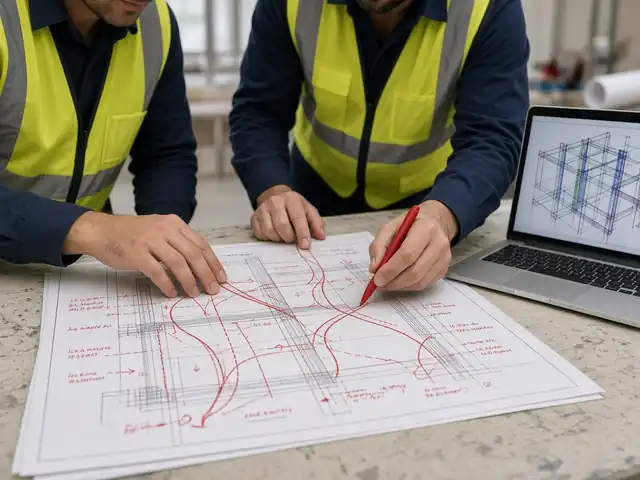
PT design review
A second check of a PT scheme.
Read more →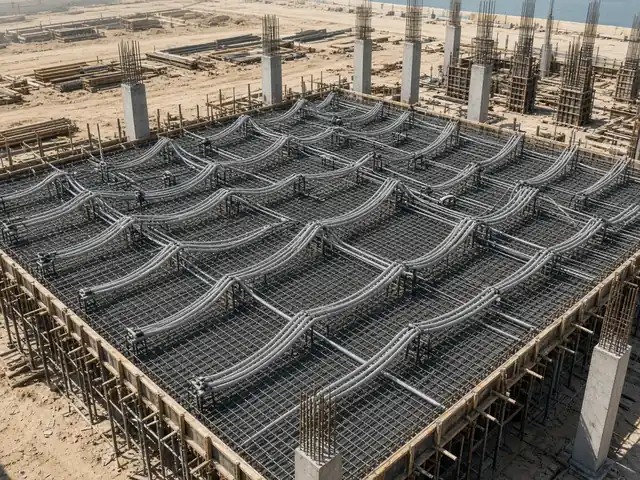
Full PT design package
Calculations, layouts and stressing schedules.
Read more →Bonded vs unbonded PT
Choosing a tendon system.
Read more →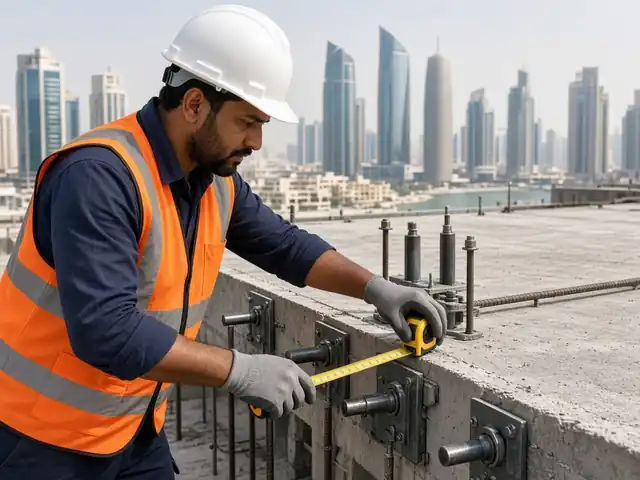
PT site supervision
Checking the tendons before the pour.
Read more →Technical information only. This article is general engineering information to help you understand the subject. It is not design advice for a specific project, codes and authority requirements change, and worked examples are illustrative. Designs must be prepared and checked by a qualified structural engineer responsible for the project, to the code edition adopted for the project. Disclaimer · Terms of use.
Send the drawings. Get an answer from our engineers.
WhatsApp or email the architectural or structural set, the location and what you need. The reply comes from the engineers who will do the work, with a proposed scope and programme.
- +971 52 118 2569
- Telephone
- +971 52 118 2569
- Office
- Al Warqa 1, Dubai, UAE
- Hours
- Sunday – Thursday, 09:00 – 18:00 GST