
Post tension design in Makkah
PT design review, optimisation, preliminary design support, full PT design packages, and stressing support for hotels, serviced residences, podiums and car parks in Makkah, designed to SBC 304 for the classified engineering office of record.
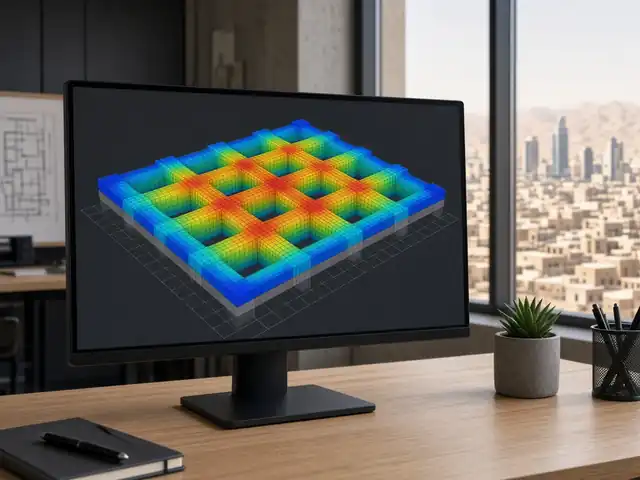
What shapes a PT slab in Makkah.
Makkah's building stock is shaped by visitors. Hotels and serviced residences, many of them tall, sit on tight urban plots with retail, restaurants and prayer areas in the podium and parking or service floors below. That combination is where post-tensioning earns its place:
- Transfer floors, where a regular guest-room column grid meets the open podium below. A PT transfer slab or transfer beam carries the offset columns in less depth than RC.
- Long-span public floors, such as restaurants, prayer halls and function rooms, where columns are unwelcome and the floor has to stay stiff under crowd loading. Deflection and footfall vibration are checked explicitly (see long-term deflection, Eurocode vs ACI and floor vibration in PT slabs).
- Repetitive hotel floors, where a thinner slab, repeated over many storeys, saves height and weight on the foundations.
Makkah is inland and set among rocky hills, so sites often have rock near the surface, deep excavations and stepped levels. Retaining walls and split levels change how a slab is restrained, which matters for shrinkage cracking on long podium floors (see shrinkage and creep in PT slabs).
What we do on Makkah projects.
Our post-tension services in Makkah
- PT design review: a check of the PT scheme, transfer floors and long-span public areas against SBC 304 before the engineering office submits.
- PT design optimisation: slab thickness and prestress on repetitive hotel floors, where savings repeat many times over.
- Preliminary design support: transfer options, slab depths and grids at concept stage, when floor-to-floor heights are being fixed.
- Full PT design package: calculation report, tendon layouts, profiles and stressing schedules for the classified engineering office's review and stamp.
- Site supervision: pre-pour inspection support and RFI answers, with site attendance arranged in the scope.
- Stressing support: stressing sequence and calculated elongations, especially for transfer elements, and record review.
Technical focus in Makkah
Heavily stressed transfer elements need the effect of their shortening on columns and walls checked; anchorage zones need bursting reinforcement designed for the actual forces (see anchorage zone and bursting reinforcement). Stressing in stages as load is added above is covered in tendon elongation calculation and elongation tolerances and stressing records.
Remote design, from Dubai.
Design is delivered remotely from our Dubai office, as the PT design partner to a classified Saudi engineering office, consultant of record or PT specialist contractor. Site attendance is arranged in the scope.
Who does the work: our engineering team brings 15+ years of post-tension design and site experience across the GCC and is led by our Lead Engineer, Mohamed Shahid. PT slabs are analysed and designed in RAM Concept, with calculations referenced clause by clause to the governing code.
Technical guides for PT design in Makkah.
Worked formulas, code clauses and FAQs from our engineering team. See the full PT design guide library.
Post-tensioned transfer slabs and transfer beams: a design guide
Load paths, harped tendons, staged stressing, deep-beam and strut-and-tie checks, deflection limits and mass pours.
Read the guide →Punching shear in post-tensioned slabs: ACI 318 vs Eurocode 2
Control perimeters, precompression and Vp, unbalanced moment and shear studs, compared across ACI 318-19 and Eurocode 2.
Read the guide →Ultimate strength and secondary (hyperstatic) moments in PT members
Tendon stress at ultimate (bonded and unbonded), secondary moments, redistribution and worked examples to ACI 318-19 and Eurocode 2.
Read the guide →Questions about post tension design in Makkah.
Who issues building permits in Makkah?
The Holy Capital Municipality (Makkah Municipality), electronically through Balady. Its requirements for commercial and residential permits include contracting with a classified engineering office and a classified construction contractor.
Does the Royal Commission for Makkah City and Holy Sites have its own requirements?
Projects within its scope can carry the Commission's own planning and design requirements. We confirm the approval route for the plot at kick-off.
Why use PT on Makkah hotel buildings?
PT transfer slabs and beams carry offset guest-room columns over open podiums in less depth, long-span public floors stay stiff with fewer columns, and thinner repeated floors save height and foundation load.
Do you check floor vibration in crowded areas?
Yes. Long-span floors in restaurants, prayer halls and function rooms are checked for deflection and footfall vibration as part of the design.
Which code do you use in Makkah?
SBC 304 for concrete and SBC 301 for loads, with PTI guidance for detailing; the edition is confirmed at kick-off.
Can you review a PT transfer slab design for a Makkah project?
Yes. A PT design review checks the model, calculations, staged stressing and detailing against SBC 304 and the project specification.
Send the drawings. Get an answer from our engineers.
WhatsApp or email the architectural or structural set, the location and what you need. The reply comes from the engineers who will do the work, with a proposed scope and programme.
- +971 52 118 2569
- Telephone
- +971 52 118 2569
- Office
- Al Warqa 1, Dubai, UAE
- Hours
- Sunday – Thursday, 09:00 – 18:00 GST