
PT stressing: elongation tolerances and records
Measured elongation is the main field evidence that a tendon carries the force the design assumes. How it is calculated, checked and recorded.
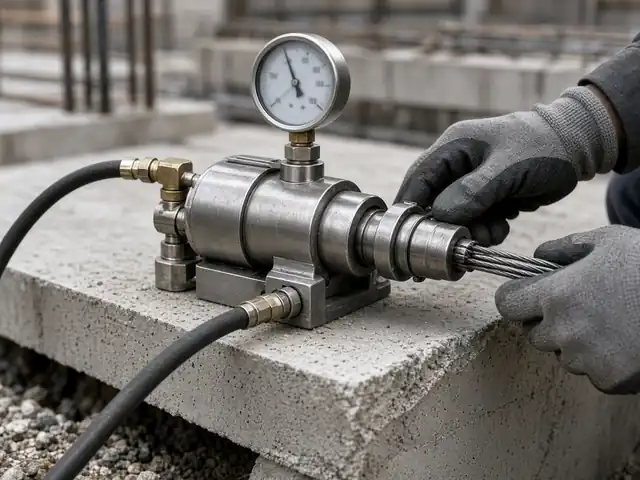
Why measure elongation?
The jack gauge tells you the force at the anchorage at the moment of stressing. It cannot tell you how much force is lost to friction along a curved tendon, or whether a tendon is blocked or kinked. Elongation can: it reflects the average strain along the tendon. Comparing measured with calculated elongation is therefore the standard field check on prestress.
How the calculated elongation is found
For each tendon, the designer takes the jacking force, applies friction losses along the profile using the curvature coefficient μ and wobble coefficient K of the approved PT system, and integrates the resulting strain using the strand area and modulus of elasticity. The modulus should come from the strand mill certificates for the batch used, because a different modulus changes the expected elongation directly. Anchor seating (wedge draw-in) is accounted for according to how elongation is measured on site.
The tolerance
A ±7% band between measured and calculated elongation is commonly used in ACI 318 based specifications and in PTI field practice for individual tendons. The project specification governs: some specifications set different limits for short tendons, for groups of tendons, or for bonded systems. Agree the limit, and the method of measurement, before stressing starts.
What a good stressing record contains
| Field | Why |
|---|---|
| Project, pour and tendon ID matching the shop drawing | Traceability |
| Date, concrete strength at stressing | Confirms transfer strength was reached |
| Jack and gauge serial numbers, calibration date | Confirms the force applied |
| Gauge pressure / jacking force | Force at the anchorage |
| Measured elongation (each stressing end) | Field result |
| Calculated elongation and % difference | Acceptance check |
| Remarks and signatures | Accountability |
When a tendon is outside tolerance
- Check the arithmetic and the calculated value, including the modulus used.
- Check the measurement reference marks and method.
- Check the jack and gauge calibration and any reading errors.
- Consider physical causes: a blocked duct, a kinked profile, a wedge slip.
- Where needed, re-stress, lift-off test or de-tension and replace.
- If a reduced force must be accepted, have the designer assess the slab with that force.
Records should be reviewed and accepted before tendon tails are cut or bonded ducts are grouted, because both steps remove the option to re-stress.
Good practice
- Issue a calculated elongation table with each pour's shop drawings.
- Use consistent marking at a fixed distance from the anchorage.
- Review records the same day, while the crew and equipment are still on the slab.
Iron Axis prepares calculated elongations and reviews stressing records as part of our stressing supervision service.
Related services and guides.
Most projects touch more than one of these. The Iron Axis home page has the full overview.

Send the drawings. Get an answer from our engineers.
WhatsApp or email the architectural or structural set, the location and what you need. The reply comes from the engineers who will do the work, with a proposed scope and programme.
- +971 52 118 2569
- Telephone
- +971 52 118 2569
- Office
- Al Warqa 1, Dubai, UAE
- Hours
- Sunday – Thursday, 09:00 – 18:00 GST