
Bonded vs unbonded post-tensioning: how to choose
Both systems are used across the GCC. Here is how they differ in behaviour, durability, construction and long-term flexibility.
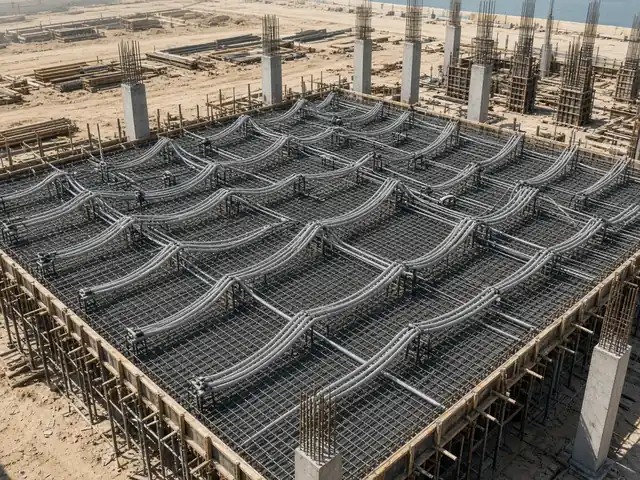
The two systems
Unbonded post-tensioning uses single greased strands (monostrands) inside an extruded plastic sheath. The strand can move relative to the concrete along its whole length; force is transferred to the slab only at the anchorages and through the profile. Bonded post-tensioning places several strands in a flat or round duct, usually galvanised steel or plastic, which is grouted after stressing so the strand bonds to the concrete along its length.
Structural behaviour
In a bonded tendon, the strand strain follows the concrete strain at every section, so at ultimate the tendon stress at a critical section approaches that of bonded reinforcement. In an unbonded tendon, the strain is averaged along the tendon length, so the stress increase at ultimate is lower and design codes such as ACI 318 give separate expressions for it. Unbonded slabs also need minimum bonded reinforcement to control cracking and provide ductility.
Construction
- Unbonded: lighter, flexible tendons, simple single-strand stressing, no grouting. Fast to lay and well suited to typical residential and office floors.
- Bonded: ducts with several strands allow larger forces per tendon and smaller anchor counts, useful for transfer slabs and beams. Grouting adds a step that needs QA: vents, grout mix, flow and records.
Durability
Both systems can be durable when detailed and built properly. Unbonded systems rely on the grease and sheath along the strand and on anchorage protection; in aggressive environments an encapsulated system protects the anchorage fully. Bonded systems rely on complete grouting; voids in the grout are the main durability risk. In coastal GCC sites with chlorides, the detailing of anchorages and pocket protection matters as much as the system choice.
Alterations and demolition
Cutting an unbonded tendon releases its force along the whole length, so openings after construction need careful engineering, de-tensioning and re-anchoring. In a bonded tendon, the effect of a cut is more local because the grout holds the strand. Either way, scanning before coring and an engineer's assessment are needed.
Fire
Fire resistance for both is governed mainly by cover to the tendons and slab thickness, set out in the applicable fire code tables. The required cover feeds back into the tendon profile and the prestress that can be achieved.
How we choose
| Situation | Often preferred |
|---|---|
| Typical residential / office flat slabs | Unbonded monostrand |
| Transfer slabs and beams with high forces | Bonded multistrand |
| Expected future openings | Bonded, or planned zones without tendons |
| Aggressive exposure | Either, with encapsulation or verified grouting |
The final choice also depends on the client's and consultant's specification and the PT specialist contractor's approved system. We design for either; see post-tension slab design, and stressing supervision for how records differ between systems.
Related services and guides.
Most projects touch more than one of these. The Iron Axis home page has the full overview.

Send the drawings. Get an answer from our engineers.
WhatsApp or email the architectural or structural set, the location and what you need. The reply comes from the engineers who will do the work, with a proposed scope and programme.
- +971 52 118 2569
- Telephone
- +971 52 118 2569
- Office
- Al Warqa 1, Dubai, UAE
- Hours
- Sunday – Thursday, 09:00 – 18:00 GST