
- Home
- Stressing & elongation records
Stressing supervision and PT elongation records
We calculate the expected elongation for every tendon, witness stressing when needed and review the measured records, so out-of-tolerance tendons are explained and resolved, not just filed.
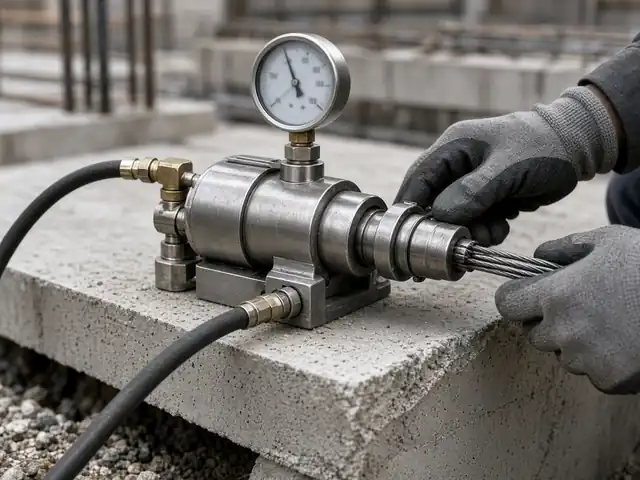
The elongation record is the proof of prestress.
Once a tendon is stressed and locked off, the force in it cannot be seen. The jack pressure tells you the force applied at the anchorage; the measured elongation tells you how much of that force made it along the tendon. Comparing the measured elongation with the calculated value is the standard way to confirm that friction, wobble and anchorage seating behaved as the design assumed.
For that reason, the stressing record is a quality record in its own right. Each tendon should have an identification that matches the shop drawing, the jack and gauge used, the gauge reading, the measured elongation, the calculated elongation and the percentage difference. Iron Axis prepares the calculated values, reviews the records and signs off or raises a non-conformance.
Calculated elongation
The expected elongation is the integral of strain along the tendon. In practice it is calculated from the jacking force, the friction loss along the profile (curvature friction coefficient μ and wobble coefficient K from the PT system's approval documents), the strand area and modulus from the mill certificates, and the anchor seating loss. For tendons stressed from both ends, the elongation is recorded at each end. We calculate elongations directly from the shop-drawing profiles, so a change in profile is reflected in the expected values.
Tolerances
A difference of ±7% between measured and calculated elongation is widely used in ACI 318 based specifications and PTI field practice as the acceptance band for individual tendons. The project specification governs and may set different limits, for example for short tendons where small measurement errors are a large percentage, or for groups of tendons in a band. We confirm the limit at the start of the job rather than assume it. More background is in our article on stressing elongation tolerances and records.
How stressing supervision runs.
- Before stressing — confirm the concrete has reached the transfer strength in the design (normally from cube or cylinder results), check that the jack and gauge calibration certificates are current and match the equipment on site, and issue the elongation table for the pour.
- Stressing sequence — confirm that the sequence follows the shop drawings, typically with distributed and banded tendons stressed in the order needed to avoid local overstress and cracking.
- Witnessing — where the scope includes it, attend stressing, spot-check the marking and measurement method, and observe lift-off checks where specified.
- Record review — check every recorded tendon against its calculated elongation, flag tendons outside the agreed band and recommend actions.
- Close-out — a signed review sheet per pour, ready to sit in the project QA file before tendon tails are cut or ducts are grouted.
When an elongation is out of tolerance.
An out-of-tolerance elongation is a signal, not a verdict. Common causes are measurement errors, a different strand modulus to the one assumed, a profile that differs from the drawing, a slipped wedge, a blocked duct in bonded systems, or a gauge reading error. The usual sequence is to check the record and calculation first, then the equipment, then the tendon itself, which may include re-stressing or a lift-off test.
| Observation | First checks |
|---|---|
| Measured elongation low | Profile and friction assumptions, blockage or kinks, gauge and jack calibration |
| Measured elongation high | Strand modulus and area, wedge slip, measurement reference marks |
| Scatter across one pour | Measurement method, crew consistency, sequence of stressing |
Where a tendon cannot be accepted, we assess the effect on the slab capacity with the reduced force and advise whether the slab is adequate, needs additional tendons, or needs another remedy. That engineering assessment is the difference between a supervisor who only records and one who can also design.
See also post-tension site supervision for pre-pour inspections.
Questions we are asked about this.
What elongation tolerance applies to PT tendons?
The project specification governs. A ±7% band between measured and calculated elongation is commonly used in ACI 318 based specifications and PTI field practice.
Who calculates the expected elongations?
Normally the PT designer, from the tendon profiles, friction coefficients and strand properties. We prepare them for our own designs and can check them for others.
Can stressing go ahead before the concrete reaches transfer strength?
No. The design sets a minimum concrete strength at transfer; stressing should wait until test results confirm it.
Can you review records from a project you did not design?
Yes, provided we receive the shop drawings, the PT system data and the calibration certificates.
Related services and guides.
Most projects touch more than one of these. The Iron Axis home page has the full overview.

PT site supervision
Pre-pour inspections of profiles, anchorages and coordination.
Read more →Elongation tolerances explained
How calculated and measured elongations are compared.
Read more →Bonded vs unbonded PT
How the system choice changes stressing and records.
Read more →
PT shop drawings
Stressing schedules and tendon identification.
Read more →Send the drawings. Get an answer from our engineers.
WhatsApp or email the architectural or structural set, the location and what you need. The reply comes from the engineers who will do the work, with a proposed scope and programme.
- +971 52 118 2569
- Telephone
- +971 52 118 2569
- Office
- Al Warqa 1, Dubai, UAE
- Hours
- Sunday – Thursday, 09:00 – 18:00 GST