
Post-tensioned vs reinforced concrete slabs in the UAE
When does a PT flat slab beat a conventional RC slab on a UAE building, and when does it not? The trade-offs, in plain engineering terms.
The short answer
For typical UAE residential and office floors with spans above roughly 7–8 m, post-tensioned (PT) flat slabs usually give a thinner slab, less reinforcement and a faster floor cycle than reinforced concrete (RC). For short spans, irregular slabs with many large openings, or buildings where future coring is expected everywhere, RC can be the simpler choice. The right answer comes from comparing both for the actual grid, not from a rule of thumb.
How the two systems work
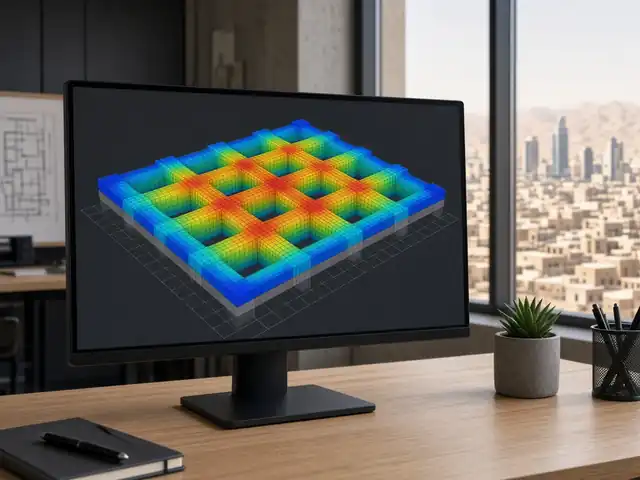
An RC slab resists bending with passive reinforcement: the concrete cracks in tension and the bars pick up the load. A PT slab adds high-strength steel tendons that are stressed after the concrete hardens. The tendon profile balances part of the gravity load, and the precompression reduces or eliminates tension under service loads. The result is a stiffer slab for the same depth, with smaller deflections and fewer cracks.
Where PT usually wins
Slab thickness and building height
Thinner slabs reduce the floor-to-floor height, and over a tower that can add up to meaningful height savings or extra floors within a height limit. Less concrete also means less dead load on columns and foundations.
Spans and column layout
PT allows longer spans with flat soffits, which suits car park podiums, open-plan offices and flexible residential layouts. Fewer columns help parking layouts and ramps.
Programme
A PT slab can usually be stressed and its formwork struck earlier than an equivalent RC slab, once the concrete reaches the transfer strength in the design. In a high-rise, that supports a shorter floor cycle.
Cracking and durability
Precompression controls cracking, which matters in the UAE's hot climate with high early shrinkage, and in exposed roofs and podium decks.
Where RC can be the better answer
- Short spans, where minimum thickness for fire, punching or services governs anyway.
- Many large or late openings, which disrupt tendon layouts and anchorages.
- Frequent future alterations, because cutting a stressed tendon needs engineering and care; RC is more forgiving to core.
- Small projects where the PT specialist's mobilisation and stressing equipment do not pay back.
Things that are often missed
Restraint. PT slabs shorten under prestress, creep and shrinkage. Stiff cores and walls restrain that shortening and can cause cracking; pour strips, temporary releases and the stressing sequence deal with it.
Punching shear. Thin PT slabs are often governed by punching at columns, especially at edge and corner columns and where seismic drift compatibility applies under ACI 318-19.
Openings and MEP. Penetrations need to be frozen before the tendon layout is issued. Late sleeves are the most common PT site problem.
Post-construction cutting. Owners and fit-out contractors must know a slab is post-tensioned and use scanning before coring.
How to compare properly
A fair comparison designs both options for the same grid, loads, fire rating and exposure, and compares concrete volume, reinforcement and PT strand tonnage, programme and the floor-to-floor height. That is part of our post-tension slab design scheme stage and our value engineering reviews. For a first look at thickness, try the PT slab thickness estimator.
Summary table
| Factor | PT flat slab | RC flat slab |
|---|---|---|
| Thickness for a given span | Thinner | Thicker |
| Economic span range | Longer spans | Shorter spans |
| Deflection and cracking | Better controlled | Needs more depth or steel |
| Late openings / coring | Needs engineering and scanning | More forgiving |
| Specialist input | PT designer and PT contractor | Standard trades |
Related services and guides.
Most projects touch more than one of these. The Iron Axis home page has the full overview.
Full post-tension design package
Scheme comparisons for your grid.
Read more →Bonded vs unbonded PT
The next decision after choosing PT.
Read more →Slab thickness estimator
A first-pass thickness check.
Read more →PT design optimisation
PT or RC, compared on one model.
Read more →Send the drawings. Get an answer from our engineers.
WhatsApp or email the architectural or structural set, the location and what you need. The reply comes from the engineers who will do the work, with a proposed scope and programme.
- +971 52 118 2569
- Telephone
- +971 52 118 2569
- Office
- Al Warqa 1, Dubai, UAE
- Hours
- Sunday – Thursday, 09:00 – 18:00 GST