
PT slab design checklist (ACI 318-19 and PTI)
The checks a two-way post-tensioned slab design should show, in the order a reviewer looks for them. Use it to review a package or to prepare one.
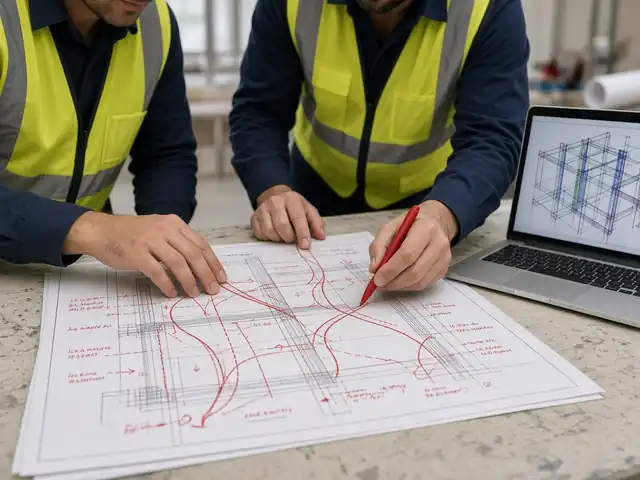
This checklist reflects common practice for two-way PT slabs designed to ACI 318-19 with guidance from the Post-Tensioning Institute (PTI), including the PTI DC80 series of design guides. It is a general aid, not a substitute for the code, the project specification or engineering judgement.
1. Design basis
- Governing code edition, loading standard and the project specification identified.
- Concrete strength at 28 days and at transfer; strand grade, area and modulus; PT system and its friction (μ) and wobble (K) coefficients.
- Exposure class, cover, fire rating and required minimum thickness.
- Bonded or unbonded system stated, and the slab classified (for example class U for two-way slabs).
2. Loads and load balancing
- Self-weight, superimposed dead, live load and partitions, with any reductions justified.
- Balanced load as a sensible fraction of self-weight, typically checked against PTI guidance for the slab type.
- Average precompression within the usual range for two-way slabs (ACI 318 sets a minimum of 0.9 MPa / 125 psi effective precompression).
3. Prestress losses
- Friction and wobble, anchor seating, elastic shortening, creep, shrinkage and relaxation, either calculated or by a justified lump-sum.
- Effective force per tendon reported at the critical sections.
4. Stresses
- At transfer: compression and tension limits for the concrete strength at stressing.
- At service: flexural tensile stress within the limit for the slab class, with bonded reinforcement where tension exceeds the threshold.
5. Strength
- Flexural strength with factored loads plus secondary (hyperstatic) effects.
- Stress in tendons at nominal strength using the correct expression for bonded or unbonded tendons.
- Minimum bonded reinforcement at columns and in positive moment regions as required.
6. Punching and one-way shear
- Two-way shear at every column, including edge and corner columns, with unbalanced moment transfer.
- Openings near columns deducted from the critical perimeter.
- Shear reinforcement (studs or stirrups) where required, and drift compatibility checks for slab-column connections in higher seismic design categories.
7. Serviceability
- Immediate and long-term deflection, including creep and cracking, against the project limits.
- Vibration where relevant for long spans or sensitive occupancies.
- Restraint to shortening from walls and cores; pour strips and sequence.
8. Detailing and drawings
- Tendon layout, profile and chair heights, minimum radius and spacing, and clearances to openings.
- Anchorage zones with bursting and spalling reinforcement.
- Stressing sequence, transfer strength and calculated elongations for every tendon.
- A note that the slab is post-tensioned, and that coring needs scanning and approval.
9. Submission
- Calculation report clause-referenced to the code, with model files provided.
- Authority review checklist completed where one applies; see full post-tension design package.
Want a second pair of eyes on a package? Our peer review service applies this list and more.
Related services and guides.
Most projects touch more than one of these. The Iron Axis home page has the full overview.
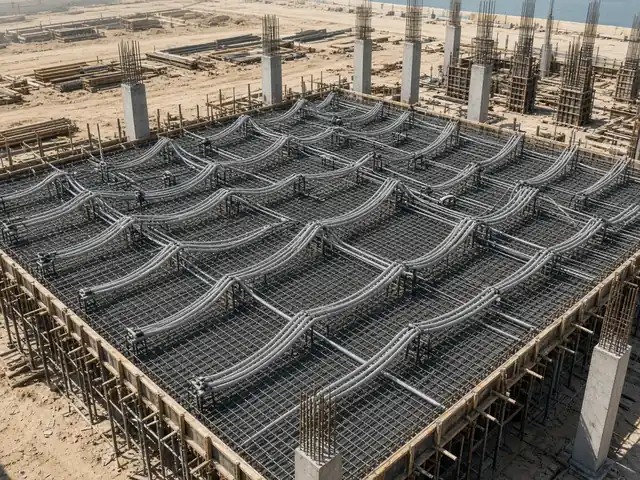
Send the drawings. Get an answer from our engineers.
WhatsApp or email the architectural or structural set, the location and what you need. The reply comes from the engineers who will do the work, with a proposed scope and programme.
- +971 52 118 2569
- Telephone
- +971 52 118 2569
- Office
- Al Warqa 1, Dubai, UAE
- Hours
- Sunday – Thursday, 09:00 – 18:00 GST