
Long-term deflection and load history: Eurocode 2 vs ACI 318
Deflection often governs the thickness of a post-tensioned slab. How EN 1992-1-1 and ACI 318-19 set the limits and calculate long-term deflection, why construction load history matters, and how RAM Concept models it.
Need a quick elastic number first? Our beam deflection calculator gives δ, reactions, SFD and BMD for simply supported, cantilever, fixed and propped beams, with the ACI 318-19 long-term multiplier.
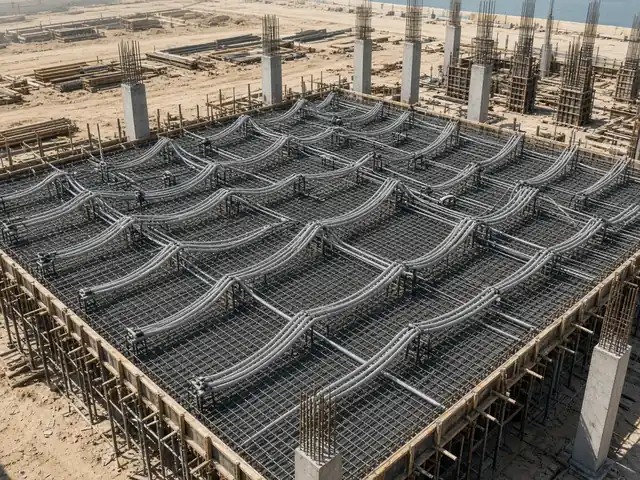
In a post-tensioned slab, the tendons balance a large part of the self-weight, so the immediate deflection under the balanced load is small. The long-term deflection is a different matter. Creep under the unbalanced sustained load, shrinkage curvature, any cracking during construction or service, and the age of the concrete when it was first loaded can multiply the short-term value several times. Deflection is often what sets the slab depth in a PT design optimisation, so it pays to calculate it properly.
What makes up long-term deflection
- Immediate deflection under the net load (applied load minus the tendon balance load), using the short-term modulus.
- Creep under the sustained part of that net load. Concrete loaded young creeps more.
- Shrinkage curvature, which arises where bonded reinforcement and tendons are placed eccentrically and restrain shrinkage on one face more than the other.
- Loss of stiffness from cracking, either under service loads or earlier, under construction loads, at a time when the concrete was weaker.
- Loss of prestress over time, which reduces the balance load; see shrinkage and creep in PT slabs.
Eurocode 2: EN 1992-1-1 clause 7.4
Limits. Clause 7.4.1 gives two recommended limits. The sag under the quasi-permanent combination should not exceed span/250 for appearance and general utility (precamber may be used to compensate, but not more than span/250). The deflection after construction, which is what damages partitions, finishes and facades, should not exceed span/500 under the quasi-permanent combination. National annexes and project specifications may set other values.
Quasi-permanent combination. Permanent loads plus prestress plus ψ2 times the variable load. EN 1990 recommends ψ2 = 0.3 for residential and office floors, 0.6 for light-vehicle car parks and 0.8 for storage, so the long-term check in an office uses only 30% of the imposed load.
Cracked and uncracked behaviour. Clause 7.4.3 interpolates between the uncracked and fully cracked values of a deformation parameter such as curvature:
α = ζ αII + (1 − ζ) αI (7.18)
ζ = 1 − β (σsr / σs)2 (7.19)
with ζ = 0 for uncracked sections. For flexure, σsr/σs may be replaced by Mcr/M. The coefficient β is 1.0 for a single short-term load and 0.5 for sustained or repeated loads.
Creep. Long-term deformation under sustained load uses an effective modulus:
Ec,eff = Ecm / (1 + φ(∞, t0)) (7.20)
where φ(∞, t0) is the creep coefficient for loading at age t0, from clause 3.1.4 or Annex B. Shrinkage curvature is given by expression 7.21. The span-to-depth ratios in 7.4.2 are an alternative for reinforced concrete, but for PT slabs a calculation is the normal route.
ACI 318-19: section 24.2
Limits. Table 24.2.2 sets maximum permissible deflections by member type and what is attached to it:
- flat roofs not supporting or attached to elements likely to be damaged: span/180, immediate deflection under roof live, snow or rain load;
- floors not supporting or attached to such elements: span/360, immediate deflection under live load;
- roofs or floors supporting or attached to elements likely to be damaged by large deflections: span/480, for the part of the total deflection occurring after attachment of those elements (the sum of the time-dependent deflection from sustained loads and the immediate deflection from any additional live load);
- the same, where the attached elements are not likely to be damaged: span/240.
Long-term multiplier. For non-prestressed members, the additional time-dependent deflection is the immediate sustained-load deflection times
λΔ = ξ / (1 + 50ρ′)
where ρ′ is the compression reinforcement ratio at mid-span (or at the support for cantilevers) and ξ is the time-dependent factor: 1.0 at 3 months, 1.2 at 6 months, 1.4 at 12 months and 2.0 at 5 years or more.
Prestressed members. ACI 318 requires the additional time-dependent deflection of prestressed members to be calculated considering the stresses in the concrete and reinforcement under sustained load, together with creep, shrinkage and the relaxation of the prestressing steel. ACI 318-19 also requires two-way prestressed slabs to be designed as Class U, so under service loads they are treated as uncracked and gross-section properties are normally used. In day-to-day practice many designers apply a creep multiplier of the same order as ξ to the sustained-load deflection, which gives a total long-term deflection of roughly three times the immediate sustained value for an uncracked slab, or run a time-dependent analysis. A Class U slab can still crack under construction loads or restraint, which is exactly where load history matters.
Side by side
| Item | EN 1992-1-1 | ACI 318-19 |
|---|---|---|
| Load for long-term check | Quasi-permanent combination (ψ2 Qk) | Sustained load (dead plus the sustained part of live, as chosen by the designer) |
| Appearance limit | span/250 total sag | No direct equivalent; span/240 for elements not likely to be damaged |
| Damage to finishes | span/500 after construction | span/480 after attachment of non-structural elements |
| Creep | Effective modulus with φ(∞, t0) | λΔ multiplier for non-prestressed members; detailed calculation for prestressed members |
| Cracking | ζ interpolation with β = 1.0 or 0.5 | Effective moment of inertia for non-prestressed members; Class U two-way PT slabs treated as uncracked |
| Shrinkage curvature | Calculated explicitly (7.21) | Included in the ξ factor for non-prestressed members |
Load history: why the construction sequence matters
Codes assume a reasonably mature slab under its design loads. Real slabs on fast-track UAE towers are often stressed within days of casting, stripped soon after, and then used to carry the weight of fresh floors above through backprops. Three things follow:
- Early-age loading increases creep. The creep coefficient rises as the age at first loading falls, so a slab loaded at a few days creeps more than the 28-day value suggests.
- Construction loads can exceed service loads. Backpropping and reshoring transfer load from the floors above. At the critical stage, a young slab can carry its own weight, the formwork and part of the weight of one or more wet slabs above, which may exceed its quasi-permanent service load.
- Cracking is not reversible. If the construction-stage moment exceeds the cracking moment of the young concrete, the slab cracks. Its stiffness for the rest of its life is governed by that peak, not by the lower service load that follows.
In Eurocode terms, this means calculating ζ using the largest moment the section has experienced and the tensile strength at that age, then applying the long-term load with the effective modulus. The Concrete Society's TR58, Deflections in concrete slabs and beams, discusses this approach in detail.
Practical measures that reduce long-term deflection include:
- stressing before formwork is struck, so the tendons balance the self-weight before the slab has to carry it;
- a backpropping scheme designed with the slab, with the number of propped levels and the stripping age agreed;
- keeping heavy material stacks off mid-span of young slabs;
- installing partitions and finishes as late as the programme allows, which reduces the deflection "after construction";
- increasing the balance load ratio within the limits of transfer stresses, or using precamber within the code limit.
How RAM Concept handles it
The standard deflection plots in RAM Concept come from a linear elastic analysis of the uncracked slab. On their own they show the immediate deflection only; long-term values then come from multipliers chosen by the designer.
For a better estimate, RAM Concept's load history deflection calculation works through a sequence of user-defined load history steps. Each step applies a load combination for a stated duration, and each takes account of the cracking, creep and shrinkage from all previous steps. The calculation includes cracking, tension stiffening, early-age concrete strength, creep (using an age-adjusted effective modulus), shrinkage, internal restraint from reinforcement and optional external restraint from stiff supports. You can choose from several creep and shrinkage models, including ACI 209R-92, ACI 209.2R-08 (GL2000), AS 3600-2018 and Eurocode 2-2004. Once a section has cracked in one step, it stays cracked for all later steps.
A typical load history for a PT floor might look like this (illustrative only; the steps and ages must come from the actual construction programme):
| Step | Load | Purpose |
|---|---|---|
| 1. Stressing | Self-weight plus balance | Transfer at the early stressing age |
| 2. Construction peak | Self-weight, balance and backprop loads from floors above | Captures early cracking |
| 3. Superimposed dead | Finishes and services | Sustained load before partitions |
| 4. Partitions installed | Partitions added | Reference point for deflection after construction |
| 5. Long-term sustained | Quasi-permanent or sustained load held for many years | Creep and shrinkage to final age |
| 6. Final instantaneous | Full service load | Maximum total deflection |
The deflection after partitions are installed is the difference between steps 6 and 4, which is the value to compare with span/500 or span/480. Two practical points: span segments or design sections must cover the whole slab in both directions, because the calculation adjusts element stiffness from the cross sections; and the I/Ig plot is worth checking, as it shows where cracking and creep have reduced the stiffness. More modelling advice is in our RAM Concept tips.
Talk to us about deflection on your PT slab. Our team calculates long-term deflection with load history in RAM Concept and checks it against the governing code. Send us the drawings for a PT design review, a PT design optimisation or a full post-tension design package, read about our post-tension design in the UAE, or contact our engineers.
Related PT design guides: RAM Concept load history deflection, precompression and balanced load, transfer and service stress checks, temperature and restraint cracking.
Part of our PT technical series. Codes are referred to by clause where we are confident of the reference; always check the edition and national annex adopted for your project.
Questions we are asked about this.
What are the deflection limits in Eurocode 2?
EN 1992-1-1 clause 7.4.1 recommends span/250 for the total sag under the quasi-permanent combination, and span/500 for the deflection after construction that could damage partitions and finishes. The national annex and project specification can set other values.
What is the long-term multiplier in ACI 318?
For non-prestressed members, ACI 318-19 multiplies the immediate sustained-load deflection by λΔ = ξ/(1 + 50ρ′), with ξ = 2.0 for five years or more. For prestressed members, ACI 318 requires the time-dependent deflection to be calculated considering creep, shrinkage and relaxation.
Which load combination is used for long-term deflection in Eurocode 2?
The quasi-permanent combination: permanent loads and prestress plus ψ2 times the imposed load. EN 1990 recommends ψ2 = 0.3 for residential and office floors.
Why are actual PT slab deflections sometimes larger than calculated?
Usually because of load history: early stripping, construction and backprop loads that crack the young slab, early-age creep, and shrinkage restraint. Cracking from a construction peak reduces stiffness for the life of the slab.
Does RAM Concept calculate long-term deflection?
Yes. Its load history deflection calculation runs a sequence of load steps with durations and accounts for cracking, tension stiffening, creep, shrinkage and restraint, using models such as ACI 209R-92, ACI 209.2R-08, AS 3600-2018 and Eurocode 2.
Can precamber be used to meet deflection limits?
Eurocode 2 allows precamber to compensate for sag, up to span/250. In PT slabs the balance load already provides an upward effect, so precamber is less common; the deflection after construction still has to meet its own limit.
Related services and guides.
Most projects touch more than one of these. See all our PT design resources, or the Iron Axis home page for the full overview.
Beam deflection calculator
Simply supported, cantilever, fixed and propped beams: deflection, SFD, BMD and L/360 checks.
Open the calculator →PT long-term prestress loss calculator
Creep, shrinkage, relaxation, elastic shortening, friction and draw-in to ACI or Eurocode 2, for 12.7 and 15.2 mm strand. Print, PDF and CSV.
Open the calculator →PT design optimisation
Thickness and prestress against deflection limits.
Read more →
PT design review
Deflection checks as part of a technical review.
Read more →Shrinkage and creep
Losses, restraint and pour strips.
Read more →RAM Concept tips
Modelling habits that change the answer.
Read more →Technical information only. This article is general engineering information to help you understand the subject. It is not design advice for a specific project, codes and authority requirements change, and worked examples are illustrative. Designs must be prepared and checked by a qualified structural engineer responsible for the project, to the code edition adopted for the project. Disclaimer · Terms of use.
Send the drawings. Get an answer from our engineers.
WhatsApp or email the architectural or structural set, the location and what you need. The reply comes from the engineers who will do the work, with a proposed scope and programme.
- +971 52 118 2569
- Telephone
- +971 52 118 2569
- Office
- Al Warqa 1, Dubai, UAE
- Hours
- Sunday – Thursday, 09:00 – 18:00 GST