How to Control PT Slab Deflection: Balance & Drape
Deflection control in post-tensioned slabs: balance the self-weight, use the full drape, stress before you strip props, and watch cantilevers and long edge spans.

Two numbers set most of a post-tensioned slab design: the average precompression and the share of the load that the tendons balance. How to pick them, the code and authority limits around them, and a worked example.
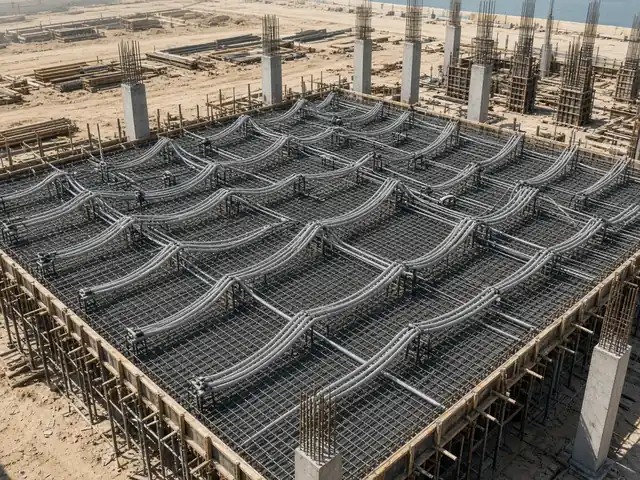
Deflection control in post-tensioned slabs: balance the self-weight, use the full drape, stress before you strip props, and watch cantilevers and long edge spans.
Why PT slabs carry a minimum average precompression, where the 0.9 MPa figure comes from, and when a higher value is used.
Every post-tensioned slab design starts with two linked decisions. The first is how much load the tendons should "carry" by their upward force, known as the balanced load. The second is the average precompression, P/A, that the tendon force produces on the concrete section. Too little, and the slab cracks, deflects and needs a lot of ordinary reinforcement. Too much, and the slab shortens more, pushes on its columns and walls, and wastes strand. This guide explains how the two are connected and where the limits come from.
A tendon draped as a parabola between two points pushes up on the concrete with a uniform load. For a parabola with drape a (the vertical distance between the chord joining the end points and the low point) over a span L, carrying an effective force P:
wbal = 8 P a / L² so P = wbal L² / (8 a)
The drape is limited by the slab thickness, the cover to the tendon at the high and low points, and the tendon size. So once the thickness and cover are fixed, choosing the balanced load fixes the force, and the force fixes the precompression. In continuous slabs the reverse curves over the supports produce concentrated downward loads that the design model also has to include; software such as RAM Concept does this from the actual tendon profile (see tendon profile and layout).
There is no code rule for the balanced load. It is a design choice, and the common practice in flat slabs is to balance a large part of the self-weight, typically in the order of 60 to 80 percent, and occasionally more of the permanent load where deflection or cracking governs. The reasoning:
Indicative values. The 60–80 percent of self-weight range is a common starting point in design practice, not a code requirement. Confirm against the project criteria and the deflection and stress checks.
ACI 318-19 §8.6.2.1 requires the effective prestress in two-way slabs to give an average compressive stress of at least 0.9 MPa (125 psi) on the slab section tributary to the tendon or tendon group. Sharjah Municipality’s building regulations ask for a P/A of at least 0.9 N/mm² in both directions, and the Ras Al Khaimah Municipality structural regulations (RAKR-S-2025) treat a slab below 0.9 MPa as reinforced concrete. The Dubai Building Code (Part F) adopts ACI 318-19 as its design basis, so the same ACI minimum applies there.
The UK Concrete Society's TR43 (2nd edition) gives guidance on typical precompression ranges for post-tensioned floors; slabs designed to it commonly fall around 1 to 2.5 N/mm². The value is not a target in itself: it is the result of the balanced load and the drape.
Indicative values. Treat the TR43 range quoted here as indicative and check the current edition for its recommended minimum and typical values.
No code sets a hard maximum for slabs, but high precompression has real costs:
Banded-distributed layouts put most of the strand in bands over the column lines in one direction and spread it uniformly in the other. Each direction is checked separately, and the tributary width matters: a band concentrates force near the column line, while ACI 318 measures the average over the tributary slab section. Where the slab thickness changes (drop panels, thickened bands, steps), the precompression in the thinner and thicker parts differs; each part should still meet the 0.9 MPa minimum.
Interior bay of a flat slab, span 8.4 m, slab 220 mm, normal-weight concrete. Self-weight is about 24 × 0.22 = 5.3 kPa. Choose to balance about 75 percent of self-weight: wbal = 4.0 kPa.
With cover and tendon size, assume the effective drape in an interior span is a = 140 mm. Then per metre width:
P = 4.0 × 8.4² / (8 × 0.140) = 252 kN/m → P/A = 252 000 / (1000 × 220) = 1.15 MPa
That is above the 0.9 MPa minimum and well below the 2.0 N/mm² Dubai trigger for detailed shortening checks. With an effective force in the order of 110 kN per 12.7 mm strand after losses, the slab needs about 2.3 strands per metre in this direction, which might be arranged as bands of four- or five-strand tendons, or as distributed tendons at about 430 mm centres. The service stresses, punching and deflection checks then confirm or adjust the choice (see transfer and service stress checks).
Indicative values. The effective force per strand depends on the jacking stress and the losses for the actual tendon; see our guide to friction and wobble losses. The numbers above are for illustration only.
| Item | Typical value or rule | Source |
|---|---|---|
| Minimum average precompression, two-way slabs | 0.9 MPa on the tributary section | ACI 318-19 §8.6.2.1 (adopted by DBC Part F); Sharjah and RAK regulations |
| Balanced load | About 60–80% of self-weight as a starting point (indicative) | Design practice; check deflection and stresses |
| Typical slab precompression | Around 1–2.5 N/mm² (indicative) | TR43 guidance and practice |
| Detailed shortening check | > 2.0 N/mm², > 50 m, or several stiff restraints | Dubai Building Code Part F (F.6.3) |
| Heavily stressed members (e.g. transfer beams) | Account for the effect of shortening on supporting columns and walls | Dubai Building Code Part F (F.6.3) |
| Punching shear credit | fpc used within 0.9–3.5 MPa | ACI 318-19 §22.6.5.5 |
Related reading: friction and wobble losses, PT flat slab vs banded beam and our PT design optimisation service, which revisits these two choices on an existing design.
Part of our PT design guides. Codes are referred to by clause where we are confident of the reference, and coefficients marked indicative should be checked against the code text; always check the edition and national annex adopted for your project. Worked examples are illustrative, not designs.
ACI 318-19 §8.6.2.1 requires an average effective compressive stress of at least 0.9 MPa on the slab section tributary to the tendon or tendon group. Sharjah and Ras Al Khaimah state the same 0.9 minimum in their own regulations, and the Dubai Building Code adopts ACI 318-19.
It is a design choice. A common starting point is about 60 to 80 percent of self-weight, adjusted so that deflection, stresses and camber at transfer all work. Balancing close to the sustained load is the most effective way to control long-term deflection.
No. Higher precompression increases elastic and creep shortening, restraint forces in columns and walls, and strand quantity. Above about 3.5 MPa ACI 318 gives no further punching shear credit, and Dubai asks for detailed shortening checks above 2.0 N/mm².
For a parabolic tendon, w = 8Pa/L², where P is the effective force, a the drape and L the span. Rearranged, P = wL²/(8a).
Yes. Each direction is checked separately, using the tributary section for that direction, and at changes in slab thickness.
Yes. Our PT design review and optimisation services check the balanced load, precompression, stresses and deflections against the governing code and the authority rules.
Technical information only. This article is general engineering information to help you understand the subject. It is not design advice for a specific project, codes and authority requirements change, and worked examples are illustrative. Designs must be prepared and checked by a qualified structural engineer responsible for the project, to the code edition adopted for the project. Disclaimer · Terms of use.
WhatsApp or email the architectural or structural set, the location and what you need. The reply comes from the engineers who will do the work, with a proposed scope and programme.