
- Home
- Post tension UAE
- Dubai
Post tension design in Dubai
Our office is in Al Warqa 1, Dubai, and most of our post-tension work is here: PT design review, optimisation, preliminary design support, full PT design packages, and site supervision and stressing support for towers, podiums, car parks and mid-rise residential buildings across the emirate.
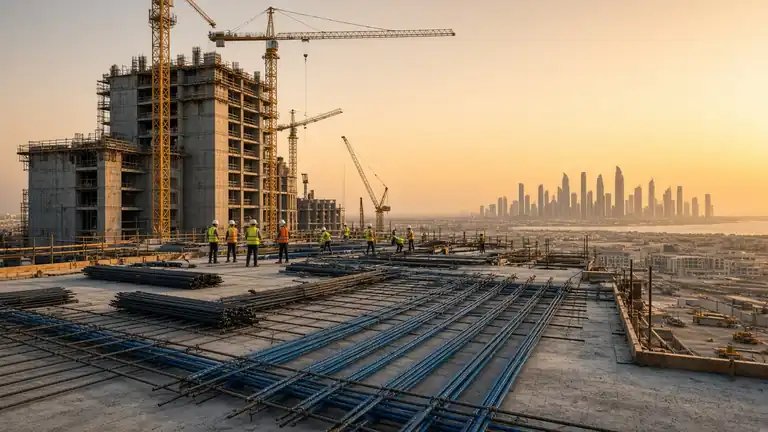
Where post-tensioning is used in Dubai.
Dubai builds post-tensioned floors at every scale. Mid-rise residential blocks in communities such as Jumeirah Village Circle, Al Furjan, Arjan and Dubai South use PT flat slabs to get the most units out of a fixed plot and a fixed height limit. Towers in Business Bay, Dubai Marina and along Sheikh Zayed Road use PT for typical floors, podium car parks and transfer levels, where a thinner slab saves height over many storeys and a longer span frees the parking grid. Hotels, offices and retail podiums add long-span ballrooms, ramps and heavy plant areas.
Because Dubai has so many PT buildings, the questions we are asked are often about existing slabs as well as new ones: a review of a PT specialist contractor's design before submission, an optimisation of slab thickness and strand quantity before tender, or a check of a new opening through an existing tendon zone (see openings and coring in PT slabs).
What we do on Dubai projects.
Our post-tension services in Dubai
- PT design review: a clause-referenced check of a PT scheme against the Dubai Building Code, ACI 318-19 and, where it applies, the DDA PT Design Review Checklist, before it goes to the authority.
- PT design optimisation: slab thickness, tendon layout and strand quantity reviewed against the DBC minimums, often on repetitive tower floors where small savings multiply.
- Preliminary design support: slab depths, column grids and transfer options at concept stage, so the architect and cost consultant work from realistic PT numbers.
- Full PT design package: RAM Concept model, calculation report, tendon layouts, profiles, anchorage details and stressing schedules for the consultant's submission.
- Site supervision: pre-pour inspection of tendon profiles, chairs, anchorages and bursting steel against the approved drawings.
- Stressing support: stressing sequence, calculated elongations and review of the stressing records against tolerance.
Technical focus in Dubai
The DBC's restraint clause matters on Dubai's long podiums and car parks, where cores, shear walls and basement walls can lock a stressed slab in place; we model the restraint and plan pour strips accordingly (see shrinkage and creep in PT slabs). Tower transfer levels are covered on PT transfer slabs and beams, and serviceability on long spans in long-term deflection, Eurocode vs ACI and floor vibration in PT slabs.
Close to site, from Al Warqa.
Our office is in Al Warqa 1, so coordination meetings at the consultant's office and site visits across Dubai fit around the pour programme rather than requiring a planned trip. We agree a written scope at the start: deliverables, comment rounds, site visits and dates.
Who does the work: our engineering team brings 15+ years of post-tension design and site experience across the GCC and is led by our Lead Engineer, Mohamed Shahid. PT slabs are analysed and designed in RAM Concept, with calculations referenced clause by clause to the governing code.
Technical guides for PT design in Dubai.
Worked formulas, code clauses and FAQs from our engineering team. See the full PT design guide library.
Temperature effects and restraint cracking in PT slabs
Estimating shortening from prestress, creep, shrinkage and Gulf temperatures, restraint forces at walls and columns, and pour strips.
Read the guide →Precompression (P/A) limits and balanced load selection in PT slabs
Choosing the average precompression and the balanced load, with ACI 318, TR43 and UAE authority limits and a worked example.
Read the guide →PT design review checklist for consultants (ACI 318-19, PTI and EC2)
What to ask for and check when reviewing a PT design: basis, prestress, stresses, strength, punching, serviceability, drawings, with hand checks.
Read the guide →Questions about post tension design in Dubai.
Which code is used for post-tensioned slabs in Dubai?
The Dubai Building Code, Part F, adopts ACI 318-19 as the design basis for post-tensioned concrete, with TR43 as further guidance and additional Dubai requirements on concrete strength, tendons, stresses, minimum reinforcement and tolerances. We confirm the edition in force at kick-off.
What concrete strength does the Dubai Building Code require for PT slabs?
At least fcu 40 N/mm² (f'c 32 N/mm²) at 28 days. A lower strength can only be used where it is shown to be suitable and accepted by the authority, with creep and shrinkage effects included.
Do you prepare PT submissions for DDA and Trakhees plots?
Yes. We prepare the PT design, calculations, drawings and checklist responses for the consultant of record, who makes the submission to DM, DDA or Trakhees as applicable.
Can you review a PT design prepared by a PT specialist contractor?
Yes. A PT design review checks the model, calculation report, tendon drawings and detailing against the Dubai Building Code and ACI 318-19, and gives a written list of findings and required changes.
Can you check whether our Dubai PT slab can be made thinner?
Yes. A PT design optimisation looks at slab thickness, prestress level, tendon layout and reinforcement within the DBC limits and the serviceability checks.
Do you attend site for pre-pour inspections and stressing in Dubai?
Yes. Site supervision and stressing support are agreed in the scope; from our Al Warqa office, Dubai sites are close at hand.
Who signs the PT design in Dubai?
PT design is carried out by a Dubai Municipality licensed post-tension design engineer. Submissions go through the consultant of record.
Send the drawings. Get an answer from our engineers.
WhatsApp or email the architectural or structural set, the location and what you need. The reply comes from the engineers who will do the work, with a proposed scope and programme.
- +971 52 118 2569
- Telephone
- +971 52 118 2569
- Office
- Al Warqa 1, Dubai, UAE
- Hours
- Sunday – Thursday, 09:00 – 18:00 GST