
Seismic design of post-tensioned slabs and flat plates
In most UAE and Saudi buildings the PT slab is not part of the seismic system, but it still has to move with the building. What that means for drift, punching shear, diaphragm action and detailing.
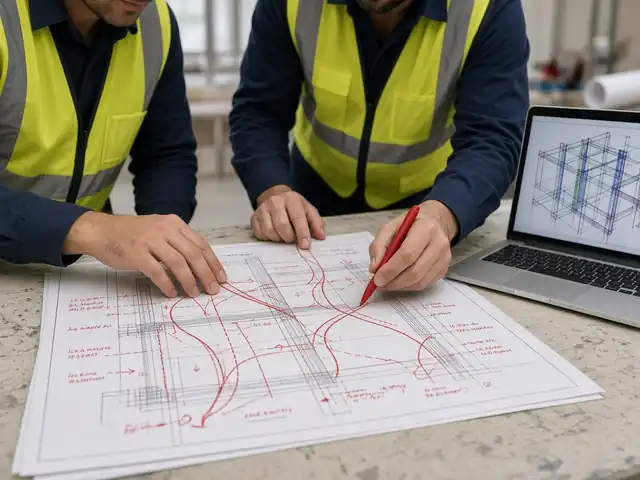
Post-tensioned flat plates are efficient for gravity loads, which is why they are the default floor system in many towers and podiums across the Gulf. Under earthquake loading the picture changes. A flat plate is a flexible frame with a brittle failure mode at the slab-column connection, so codes generally do not rely on it to resist earthquakes. Instead, cores, shear walls or moment frames take the lateral load, and the slab is designed to follow the building's displacement without losing its ability to carry gravity load. This guide covers the checks that make that work.
Seismic context in the UAE and Saudi Arabia
Seismic demand varies across the region. Most of the UAE is in a low-to-moderate seismic zone, with higher demand towards the east and north-east near the Zagros and the Hajar mountains, which affects Fujairah, Ras Al Khaimah and parts of the eastern emirates. In Saudi Arabia, the Saudi Building Code SBC 301 (Loads and Forces) sets the seismic loads; the western region, particularly the north-west towards the Gulf of Aqaba and the volcanic fields of the Hejaz including the area around Madinah, generally has higher demand than Riyadh or the Eastern Province. SBC 304 (Concrete) follows ACI 318 closely for detailing. Each project's seismic design category depends on the mapped spectral accelerations and the site class from the geotechnical report, so we always start from the project-specific values rather than an emirate or city average.
Indicative values. Regional seismic descriptions here are general. Always take the design spectral accelerations, site class and seismic design category from the governing code maps and the project geotechnical report.
The flat plate is usually not the seismic system
Under ACI 318-19 and ASCE 7 (which SBC 301 broadly follows), two-way slabs without beams can form an intermediate moment frame only in the lower seismic design categories, and they are not permitted as part of the seismic-force-resisting system in Seismic Design Categories D, E and F. In those categories the slab-column frame becomes a "member not designated as part of the seismic-force-resisting system", covered by ACI 318-19 §18.14. The slab must still:
- carry gravity loads while the structure goes through the design displacement;
- act as a diaphragm, transferring lateral forces into cores and walls through collectors and chords (ACI 318-19 Chapter 12 and §18.12);
- keep the slab-column connections from punching under the combined effect of gravity shear and the unbalanced moment that drift induces.
Drift compatibility and punching shear
When the building sways, the slab rotates relative to the column. That rotation transfers unbalanced moment into the connection and raises shear stresses on one face. Test data show that the drift a slab-column connection can tolerate drops sharply as the gravity shear ratio rises. ACI 318-19 §18.14.5 uses this relationship: slab-column connections of two-way slabs without beams must have shear reinforcement unless the design story drift ratio is below a limit that depends on the gravity shear stress ratio vuv/(φvc).
Nonprestressed slabs: shear reinforcement needed if Δx/hsx ≥ max[0.005, 0.035 − (1/20)(vuv/φvc)]
Unbonded PT slabs (fpc meeting §8.6.2.1): shear reinforcement needed if Δx/hsx ≥ max[0.01, 0.04 − (1/20)(vuv/φvc)]
Where required, the shear reinforcement must provide at least vs = 0.29√f'c (MPa) at the critical section and extend at least four times the slab thickness from the column face. Headed shear studs are the usual solution because they fit between tendons and bottom bars.
Indicative values. The drift thresholds and the 0.29√f'c / 4h requirements are quoted from ACI 318-19 §18.14.5.1 as we understand them. Check the clause, its notation and any exceptions in the edition adopted for your project.
Two practical consequences follow. First, the gravity shear ratio matters as much as the drift: a connection with vuv at 30 percent of φvc tolerates far more drift than one at 70 percent. Second, the design story drift comes from the lateral system, so a stiffer core helps the slab. The punching check itself is covered in our punching shear guide.
Worked check (illustrative)
An unbonded PT flat plate in SDC D with a gravity shear ratio vuv/φvc = 0.5 at an interior column:
Limit = max[0.01, 0.04 − 0.5/20] = max[0.01, 0.015] = 0.015
If the design story drift ratio from the lateral analysis is 0.012, it is below 0.015 and shear reinforcement is not triggered by this clause. At a ratio of 0.018 studs would be needed. A nonprestressed slab at the same shear ratio would have a limit of max[0.005, 0.010] = 0.010, which shows why ACI 318 recognises the benefit of precompression.
Integrity reinforcement
If a connection does punch, the slab should hang on the column rather than fall onto the floor below. ACI 318-19 §8.7.5.6 (for PT slabs) requires at least two tendons of 12.7 mm or larger strand in each direction to pass through the column core or, alternatively, bottom bonded reinforcement through the column. Bottom integrity steel per §8.7.4.2 applies to nonprestressed slabs. In seismic design this detail is not optional; it is part of the collapse-prevention logic.
Diaphragm, collectors and the core connection
PT slabs make good diaphragms because precompression helps keep them uncracked, but the forces still need a path into the walls. Points to check:
- Collector and chord forces from the diaphragm analysis, with bonded reinforcement to carry them. Precompression from unbonded tendons is not counted as collector reinforcement in the usual design approach.
- Large openings near cores, which interrupt the load path (see openings and penetrations in PT slabs).
- Shear friction at the slab-wall interface and the wall dowels or couplers.
- Restraint from cores, which also matters for shrinkage and temperature (see temperature and restraint cracking).
Eurocode 8 and other codes
Projects designed to Eurocode 8 treat flat slab frames in a similar way: they are usually "secondary seismic members", which must stay elastic or retain gravity capacity at the design displacement (EN 1998-1 §4.2.2). In both systems the engineering logic is the same: keep the slab connections capable at the expected drift and give the gravity load a backup path.
Summary
| Check | Rule | Reference |
|---|---|---|
| Flat plate as the seismic system | Not permitted in SDC D–F; gravity frame instead | ACI 318-19 Ch. 18; ASCE 7 / SBC 301 |
| Drift compatibility, unbonded PT | Studs if drift ratio ≥ max[0.01, 0.04 − vuv/(20φvc)] (indicative) | ACI 318-19 §18.14.5.1 |
| Drift compatibility, nonprestressed | Studs if drift ratio ≥ max[0.005, 0.035 − vuv/(20φvc)] (indicative) | ACI 318-19 §18.14.5.1 |
| Required shear reinforcement | vs ≥ 0.29√f'c, extending 4h (indicative) | ACI 318-19 §18.14.5.1 |
| Structural integrity | Two tendons each way through the column, or bonded bottom bars | ACI 318-19 §8.7.5.6 |
| Diaphragm | Collectors and chords with bonded steel | ACI 318-19 Ch. 12, §18.12 |
| Eurocode projects | Secondary seismic members keep gravity capacity at design displacement | EN 1998-1 §4.2.2 |
For a project-specific check, our PT design review covers the drift-compatibility and diaphragm checks alongside the gravity design.
Part of our PT design guides. Codes are referred to by clause where we are confident of the reference, and coefficients marked indicative should be checked against the code text; always check the edition and national annex adopted for your project. Worked examples are illustrative, not designs.
Questions we are asked about this.
Can a PT flat plate resist earthquake loads?
In low seismic design categories a two-way slab frame can form part of the lateral system. In SDC D, E and F, ACI 318 does not permit it, so cores, walls or moment frames carry the lateral load and the slab is designed as a gravity frame that follows the drift.
Why are slab-column connections critical in earthquakes?
Drift rotates the slab relative to the column and adds unbalanced moment to the gravity shear. A connection already highly stressed by gravity can punch at small drift, which is why ACI 318 links the allowable drift to the gravity shear ratio.
Does post-tensioning help seismic performance?
Precompression raises punching capacity and ACI 318-19 §18.14.5.1 gives unbonded PT slabs a more generous drift threshold than nonprestressed slabs. Integrity tendons through the columns also give a backup load path.
Is the UAE a seismic zone?
Most of the UAE has low to moderate seismic demand, generally higher towards the north-east and east. The design values for a project come from the governing code maps and the site class in the geotechnical report.
Which Saudi code covers seismic design?
SBC 301 sets the seismic loads and SBC 304 covers concrete design and detailing, closely following ASCE 7 and ACI 318.
Do shear studs help with drift?
Yes. Headed shear studs at the slab-column connection increase punching capacity and deformation capacity, and are the usual way to satisfy the drift-compatibility requirement.
Technical information only. This article is general engineering information to help you understand the subject. It is not design advice for a specific project, codes and authority requirements change, and worked examples are illustrative. Designs must be prepared and checked by a qualified structural engineer responsible for the project, to the code edition adopted for the project. Disclaimer · Terms of use.
Send the drawings. Get an answer from our engineers.
WhatsApp or email the architectural or structural set, the location and what you need. The reply comes from the engineers who will do the work, with a proposed scope and programme.
- +971 52 118 2569
- Telephone
- +971 52 118 2569
- Office
- Al Warqa 1, Dubai, UAE
- Hours
- Sunday – Thursday, 09:00 – 18:00 GST